

BOḰEĆEN S’uylu Skweyul
(Pauquachin Spirit Days)
and Sea Garden Restoration
2025 Gathering Overview
Yu sq'uq'a' kwthu xe'xe' smunmeent
(together with our sacred rocks)

BOḰEĆEN S’uylu Skweyul (Pauquachin Spirit Days) and Sea Garden Restoration Gathering was a 3-day international multi-cultural engagement.
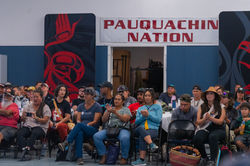
Pauquachin First Nation (PFN) and Pauquachin First Nation Marine (PFNM) were honoured to welcome everyone with open arms and hearts. After ten months of planning, 34 dedicated Pauquachin staff, PFN Chief and Council, Elders, Youth, Indigenous and non-Indigenous local businesses, community sponsors, international guests, enthusiastic volunteers, and neighbouring First Nations, came together on August 6, 7 and 8, 2025 to be a part of reclaiming Coles Bay by creating and building a traditional Sea Garden (Clam Garden). PFNM is leading this heritage project with the goal of supporting culture revitalization, restoring traditional food sources, and actively supporting ecological health within the bay.
Traditionally, Pauquachin Spirit Day is an annual 1-day Gathering designated for community members (only) to celebrate the passing year with games, food, events, singing, and more.
This year, due to overwhelming support, the Gathering was extended to include a major undertaking and push for Pauquachin First Nations’ Douglas Treaty Rights to continue “fisheries as formerly”. The chosen action, with four years of conceptual development, cultural inputs, community involvement, and engagement, was implemented through the completion of a new sea garden, also known as a clam garden.
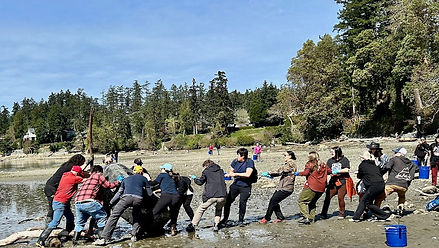
Proudly welcoming our relations from all over the Pacific. Our guests joined us from Aotearoa (New Zealand), Hawai’i, Palau, Haida Gwaii, Alaska, and Washington State. A unique and very special weaving of Indigenous cultures gathered and together with over 300 helping hands, were able to complete 400 feet of new sea garden wall. This is in support of Pauquachins’ ongoing fight to re-access shellfish harvesting beds in Coles Bay, which have been closed since 1997. As this legacy wall continues to be built and maintained, we are reawakening traditional practices with our future generations. With ancestral sea gardens being aged over 4000 years old, this project is intended to support other First Nations in like-minded restoration projects of their own.
During the Gathering, PFNM also released the Shellfish Harvest Restoration Handbook. For nearly 30 years, shellfish harvesting has been closed in Coles Bay, located in Saanich Inlet on southern Vancouver Island, British Columbia (B.C.). This closure has directly affected BOḰEĆEN (Pauquachin) First Nation’s important shellfishery and deeply impacted the way of life of Pauquachin community members. This Handbook includes an overview of Pauquachin First Nation’s efforts to restore their traditional shellfish harvesting beds at Coles Bay. Restoration of the shellfish harvest requires a co-governance approach with municipal, provincial, and federal governments, which PFN initiated and continues to lead.
Restoration at Coles Bay aims to reinstate food sovereignty for PFN community members by jointly addressing the long-term septic and stormwater pollution that has been impacting the site for decades, and reawakening cultural practice, stewardship, and knowledge transfer at the site.
Coles Bay was and continues to be impacted by ecological and human challenges. For PFNM Stewards, this is an opportunity to solve a multitude of problems within one ecosystem. The act of harvesting fosters ongoing opportunities for Elders to teach the young about responsibilities to their relatives, how to manage marine resources, and how to cultivate, prepare, and share food according to cultural protocols and the laws and obligations Pauquachin community members have to each other and the environment.
The Shellfish Harvest Restoration Handbook is only one example of many opportunities to restore Indigenous food systems along B.C.’s coast. Indigenous Nations, both across B.C. and beyond Canadian borders, are conducting similar restoration work within their traditional food systems, many of which collaborated and contributed to the solutions and actions taken by Pauquachin First Nation to ensure healthy shellfish access for the community. Designed to serve as a tool to inform and guide other coastal First Nations communities that are striving to restore and revive traditional shellfish harvesting practices in their communities.
This is a new responsibility. For all W̱SÁNEĆ Peoples, this is a new inheritance and a return to a practice that was made to go asleep over 100 years ago due to settler expansion. We will continue and respectfully steward this place, caring for all the harvestable foods that will return here.
Huy tseep q’u siem nu siieya.


Our Gathering Story:
Leading up to the Gathering:
-
Volunteer Days (May, June & July)
-
Regular Community Beach Clean-ups
-
Hosted 'Pulling Together' - Canoe Journeys (July)
-
Featured in Pulse Magazine (Vital Signs Summer 2025 edition and Victoria Foundation)
The Sea Garden Restoration Gathering:
-
Constructed 400 + feet of sea garden rock wall in 2 days
-
Filmed 2 documentaries (coming 2026)
-
Welcomed 600 + people daily over 3-days
-
98% of Gathering Contractors are Indigenous Businesses
-
Hosted an Indigenous Community Market (with 30 local vendors)
-
Only 1-bag of garbage over 3-days due to planning, sorting and phenomenal support
-
Released the Shellfish Harvesting Restoration Handbook
*See below for list of Gathering Partners, Relations & Sponsors
What's Next?
-
Shifting into the next lifecycle of the project - development of the Community Shellfish Harvesting Plan
-
Community participation and verification
-
Talking Circles
-
Working Groups with organizations, government, municipalities, etc.
-
Regulatory Workshops
-
Ongoing, sharing, learning and maintenance of the sea garden wall and Coles Bay

The Happy Clam Logo
The Happy Clam is healthy, happy and a great source of nourishment for our people. On its shell are the phases of the moon which affect the tides of the ocean, allowing us to harvest when it is low. With its siphon out it is ready to filter the oceans water, to breathe, eat, and reproduce. It lays in a sea of blue filled with stars and a sun with a salish eye looking down. Encasing the cosmos is a ring of sand, the environment that homes the happy clam.
Raven (Darcy Treadwell) Pauquachin Member
Huy ch q'u siem,
to all our Gathering
Partners, Relations & Sponsors
We strongly recommend these local and amazing organizations and businesses.
*All photos used on this page were consented to media use and credits/links noted.